Thursday, December 23, 2010

Visiting Shin'ei Middle School & Sapporo Kaisei Senior High School

Shin'ei Middle School, Sapporo, Japan
The students in Japan don't start their summer vacations until July 21st.  So while we were in Sapporo we were pleased to be able to visit two schools.  In the morning we visited Shin'ei Middle School.  The middle school is home to about 800 middle schoolers from the 7th to 9th grades.  The students greeted us very warmly and we greatly enjoyed the smiles and enthusiasm on the faces of the teachers and students we met. 
The students have to take their shoes off before entering the school and put on their "inside sneekers."  We had to take our shoes off as well.  Since we didn't have "inside shoes" we were provided with slippers and we put our shoes in a plastice bag.
The students were all very excited to see us and to practice their English skills.  I was greeted by many "Hello's" and  "Nice to meet you's!"  I had fun responding back in English as well as Japanese, "Konnichiwa" and " Hajimimashte!"  I visited many classrooms including a Social Studies classroom.  I was able to chat with a few students about the geography they were learning.
I had lunch with a 7th grade class.  This is a picture of my lunch group.  In Japan the students don't change classes (except for Science and technology lab) the teachers do.  Also, the students don't eat lunch in a cafeteria.  They eat in their classrooms with their teacher.  We had a delicious, freshly prepared lunch of rice and beef, miso soup, pickeled greens and of course milk! 
The students have assigned jobs that include serving their fellow students.  And of course the students must clean up after they're done eating.  Food not eaten is placed in the proper pans for recycling. 
Sapporo Kaisei High School (Student Bike Racks)
In the afternoon we visited the Sapporo Kaisei Senior High School.  This school for 10th-12th graders focuses on English learning for the medical/science fields.  Japanese teenagers can't get their drivers license until 18, so they ride their bicycles to school in.  The school day starts around 87:30 am and lasts until 5pm.  The students have their classes and then attend afterschool clubs. 
We visited an English language class and watched as the students used technology to improve theirEnglish  language skills.  Afterwards we listened to some students give a presentation in English on various aspects of Japanese culture.

Tuesday, December 21, 2010

Shopping in Japan

Electronics Store in Japan (Photo by S. Kopecki)
Japan is a shopper's paradise, offering everything from high-tech gadgetry and electronics to traditional arts and crafts. Large department stores, specialty shops, fashion boutiques, hotel arcades and shopping centres abound. Popular buys include cameras, watches, CD players, hi-fi equipment, silk goods, lacquer ware, Japanese dolls, and woodblock prints.

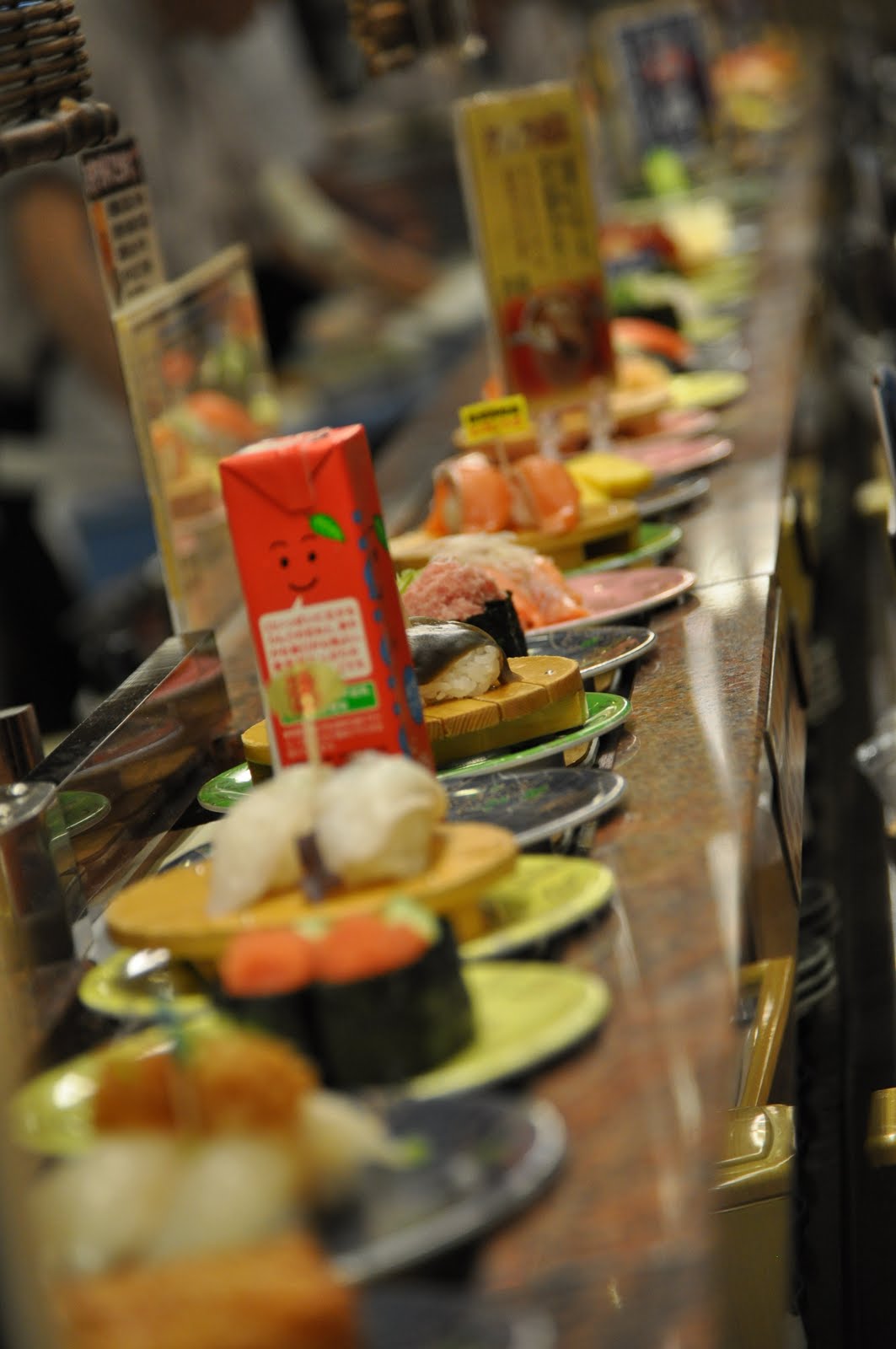
Revolving Sushi Bar at Sopporo Station

NCTA Group Enjoying Revolving Sushi Bar (Photo By S. Kopecki)
Photo By S. Kopecki

 Imagine.....sitting at the counter and watching your favorite pieces of sushi and sashimi (raw fish on rice or alone) passing you by on a conveyor belt....So many decisions....What should I get?????....the plates are color coded to help you with pricing....One important rule to remember....once you pick up the plate of your choice it's yours!  There's no putting it back.  Japan is VERY serious about food freshness, expecially since fresh fish is so much apart of their daily diet.

Monday, December 20, 2010

Welcome to Tokyo!

Pokeman is Everywhere in Japan! (No, we didn't fly in this plane)
After four wonderful days in Sapporo the group hopped on a Nippon Airways plane for the 90 minute flight to Tokyo, the capital of Japan.  Tokyo is located on the eastern side of the main island of Honshu.  Honshu is the largest of the four main islands of Japan, with a population of nearly 100 million.  The Japanese Alps run through the center of Honshu.  The highest peak is Mt. Fuji which is near Tokyo.  It is an inactive and is over 12,000 ft.  70% of Japan is mountainous with many active volcanoes.   There are a lot of earthquakes in Japan because it lies on an unstable part of the earth's crust.  About 1000 earthquakes occur each year.  Will one occur while I'm here?  Tokyo lies in the humid subtropical zone, so we were prepared for the hot and humid days that lay ahead of us.  As it was early July, the spring rainy season was just coming to an end.  

"Salarymen" coming home from work.


Tokyo is a major metropolitan city and has a population of over 12 million!  It's very similar to New York City.  It is a very bustling city filled with neon signs and lots of traffic and people coming and going everywhere.  It is one of three world finance centers, along with New York and London.  It is the most expensive city to live in in the world!  People use many modes of transportation in order to get around the city but the Tokyo Subway is the primary mode of transportation in the city.  


Tokyo Skyline


Entrance Gate to Senso-ji


It also holds on to the traditional through its tranquil backstreets and its temples and shrines.  The first day we were in Tokyo, a small group of us went to the Asakusa section of Tokyo to visit the city's major Buddhist Temple Senso-ji. 


The Nakamise-dori
Before making our way to the temple we passed throuh stalls that have been peddling their trinkets and wares, such as beautifully crafted hair combs and paper fans as well as calligraphy brushes to the crowds for centuries. 


Red Bean Cake Maker (Photo By S. Kopecki)
 There are also restaurants and fast food stands selling red bean cakes and sembei rice crackers. 


Young women wearing the kimona and eating a rice cake!


Insense Burner (Photo by S. Kopecki)
We finally made our way to the main temple complex.  I fanned a waft of smoke-breath of the gods- over myself to take in its curative powers.  I then went over and purified myself before entering the temple itself.  The temple is dedicated to the Kannon, the bodhisattva of compassion. 
Photo By S. Kopecki
Once inside a stopped a moment to pray and then went to the side to see what message the bodhisattva has for me.  Through a formula of numbers on a stick.  I shook out of a box I was able to pull my "fortune" out of a corresponding numbered drawer.  My message from the boddhisatva was not a cautionary one!  A message to me to "fix up" a certain area of my life.  These messages, along with positive messages are all important messages for our spiritual development. 

Photo By S. Kopecki
Our guide informed me that since my fortune (along with the fortunes of a few others in our group) was not a positive one, I may want to leave it behind so the boddisatva may help me with it and the bad fortune will not come to pass. 


So we tied our "bad fortunes" to the rack and we left the temple with our bad fortunes behind us!

Photo By S. Kopecki


Sunday, December 19, 2010

The Tokyo Wholesale Fishmarket, Tsukiji

Looking for something to do while in Tokyo at 4:30 am?  Well, the Tokyo Wholesale Market is the place for you!  The Japanese are a vracious seafood-eating nation.  It's a staple of their diet (although it has been in a decline in the last few years) and there are over 900 local fish markets all around Japan, with the Tokyo Fish Market, Tsukiji being the center of the fish universe. Tokyo Bay used to be the major source of fish.  Nowadays most of Tokyo's fish production comes from the outer islands, such as Izu Oshima and Hachijojima.


The fish market starts very early in the morning, preparing to supply the city residents with all their fish needs.  After taking a taxi from our hotel, we arrived at the entrance to the entered the market at 4:30 and were given our florescent tees to wear.  We waited in line until 5:30 and then were brought, dodging mini-forklist truck that shift the produce around, to the tuna auction area, where for 1/2 hour we observed the men preparing the frozen tuna for auction.

The inspectors check the tails of the tuna for freshness and quality.  A high quality tuna can sell for between 6,000 and 10, 000 dollars! 


The sound of a bell marks the beginning of the auction where a whole floor of tuna is sold in minutes. 


Sushi Chef at Tsukiji  (Photo By S. Kopecki)
I love the tuna sushi! (Photo by S. Kopecki)
After our time observing the tuna auction ended, we made our way to some sushi stalls for a breakfast of sushi, miso soup, a tasty egg dish and green tea.

Saturday, December 18, 2010

A Keiseki Meal

While in Tokyo, the group had a Kaiseki meal for lunch.  Kaiseki-ryori is one of Japan's finiest and most expensive styles of cooking.  It is made up of a series of small, carefully balanced and expertly presented dishes.  Ours being a luncheon, the meal came in a traditional laquerware bento box.  A keiseki meal is meant to be a feast for all the senses.  The atmosphere of the room was exquisite as well.  We sat on the tatami mats and a waitress in a kinomo served us our meal.  The tokononoma hung on the wall of our private banquet room and a beautiful fish pond and stone lantern were on view outside our windows. 

Friday, December 17, 2010

Take Me Out To The Ballgame!

Tokyo Dome (Photo by S. Kopecki)
Take me out to the Tokyo Dome for a classic Japanese pastime-baseball! 


Cheering Fans (Photo by S. Kopecki)
It was the Hokkaido Nippon Ham Fighters  vs.Softbank.  Japanese baseball may be an American import (from the 1930s) but the style of the game is totally Japanese.  It's more face-paced and the crowd is always very participatory.  Lots of the fans, still dressed in their business attire, throw on their favorite player jersey and bang their clappers together in uison with the organized cheering groups.

Hokkaido's Number One Fan (Photo by J. Donegan)


Photo By S. Kopecki
There's the traditional hotdogs, popcorn and coke to enjoy along with other more Japanese treats (like Indian currry). 
Yum! (Photo By S. Kopecki)