Monday, September 6, 2010

Kyoto Temples and Shrines


Kiyomizudera Temple, Kyoto
Kyoto, located in central Honshu, was the capital of Japan for more than a thousand years and is filled with Buddhist temples, shrines, gardens, and palaces.  It is also home to the country's most important works of art, its richest culture and most refined cuisine.  Kyoto hangs on to its rich history and high culture and visitors today can still see streets of traditional wooden houses, hear the click-clack of geta (traditional wooden sandals) walking on the paving stones, see geisha passing in a flourish in their silk kimonas and view temple pagodas surrounded by cherry blossom trees.

Jishu Shrine-The Cupid of Japan


The Golden Pavilion-Kinkaku-Ji Temple
I visited a few of Kyoto's shrines and temples while in Kyoto, many with the group and some on my own during our free day and during my extended stay in Kyoto.  Perhaps because I was able to linger in Kyoto longer than any other stop along the tour (partly because Susan and I extended our stay here another two days), I began to feel the spirit of Japan here in Kyoto.  It was hard to leave after spending nearly a week visiting museums, temples and shrines, being part of the Gion Matsuri celebration and enjoying the people and cuisine the city has to offer. 


Kinkaku--Ji Temple Grounds
 On day one in Kyoto, we left our ryokan in the Eastern Gion District of Kyoto and made our way up Kiyomizuzaka street to the Kiyomizu-dera Temple.  For over 1,000 years pilgrims have climbed the slopes to this temple to pray to the temple's 11-headed Kannon image and drink from its sacred waters.  While touring this temple I lingered in the main sanctuary for awhile while taking in the panoramic view from the temples veranda.  I then made my way to the Jishu Shrine, dwelling place of the god of love and matchmaking.  Many young people come here to pray for future happiness, while many parents come to pray for their children.  Before leaving the temple complex, I joined the line of my fellow pilgrims to drink from the sacred waters spring (Kiyomizu means pure water in Japanese). 

For the remainder of the day we crisscrossed the city visiting the major temples and shrines.  One was Kinkaku-Ji, or Golden Pavilion.  Originally the retirement villa for the 14th century shogun, Yoshimitsu.  Upon his death, the villa was turned into a Zen Temple.  The temple sits on the side of a central pond garden and is completely covered in gold leaf and topped with a golden phoenix.  I marveled at the structure, noting rather sadly that I was not looking upon the original but an exact replica rebuilt after a fire completely destroyed it in 1950.  We walked the temple gardens trying  to be take in the serenity of the place, at the height of the tourist season!

Ryoan-ji Temple Zen Rock Garden
 Temple number three of the day was Ryoanji Temple.  This temple's claim to fame is its Zen rock garden.  The garden is made up of white gravel and  15 stones arranged in a perfect zen-like manner.  I sat for a few moments on the temple's veranda and contemplated the meaning of the arrangement.  A Zen masters display on the meaning of life and open to a multitude of interpretations. 


Ryoan-Ji , Pond Garden


After lunch we visited the Ninna-Ji Temple, once the home of the ex-emperor in the year 888.  It is noted as the headquarters of the Omuro School of the Shingon sect of Buddhism.  This temple is noted for its colossal front gate and five story pagoda dating back to the 1630s.  The final site of the day was Heian Shrine, one of Kyoto's largest and newest shrines, built in 1895.


1001 Kannons at Sanjusangen-do Temple
 There are sooooo many temples and shrines in Kyoto, that one can go crazy trying to exolore them all.  With so a short time in Kyoto, we were limited as to how many we could visit.  My friend Susan and I extended our stay in this historical city and therefore were able to explore two more amazing sites.  One was a templa and one was a shrine.  First caught the city bus to visit the Sanjusangen-do Temple.  This temple left me speechless for inside the long main hall stand 1,001 life-size Kannon (Goddess of Mercy) images!  The main hall is the largest wooden structure in the world, dating back to 1164 and the Kannon statues date back to 1254 and were carved by Tankei at the age of 82.

The most famous of all the thousands of shrines dedicated to Inari, the god of sake and rice  is the Fushimi Shrine in the district of Fushimi, a short distance from Kyoto.  The shrine sits at the base of Mt. Inari and includes trails up the mountain to many smaller shrines.  The afternoon was a memorable one as we made our way upwards while under the arches of hundreds of vermillion torii gates.  Our spiritual pilgrimage was enhanced by a light rain and thunder (marking the end of the rainy seeason).   We walked up thousands of stone steps up the mountain alonside other spritual devotees.  Along the way were thousands of  Otsukas built by the many faithful.  The way up is dotted with little shops that serve as places for the visitors to rest and refresh by selling drinks and snacks.  On the way down we stopped in a small store that sold souveniers for the pilgrims  as well as being a place for the faithful to deposit their offerings of rice and sake to the god Inari.  We both were greeted warmly by the man who ran the shop, and we discovered lived there.  As we sipped tea, he engraved our torii gates souveneirs with blessings of long life and happiness for ourselves and our families.  We we returned to our ryokan, it was time to get ready for the Gion Matsuri!


A Kyoto Ryokan

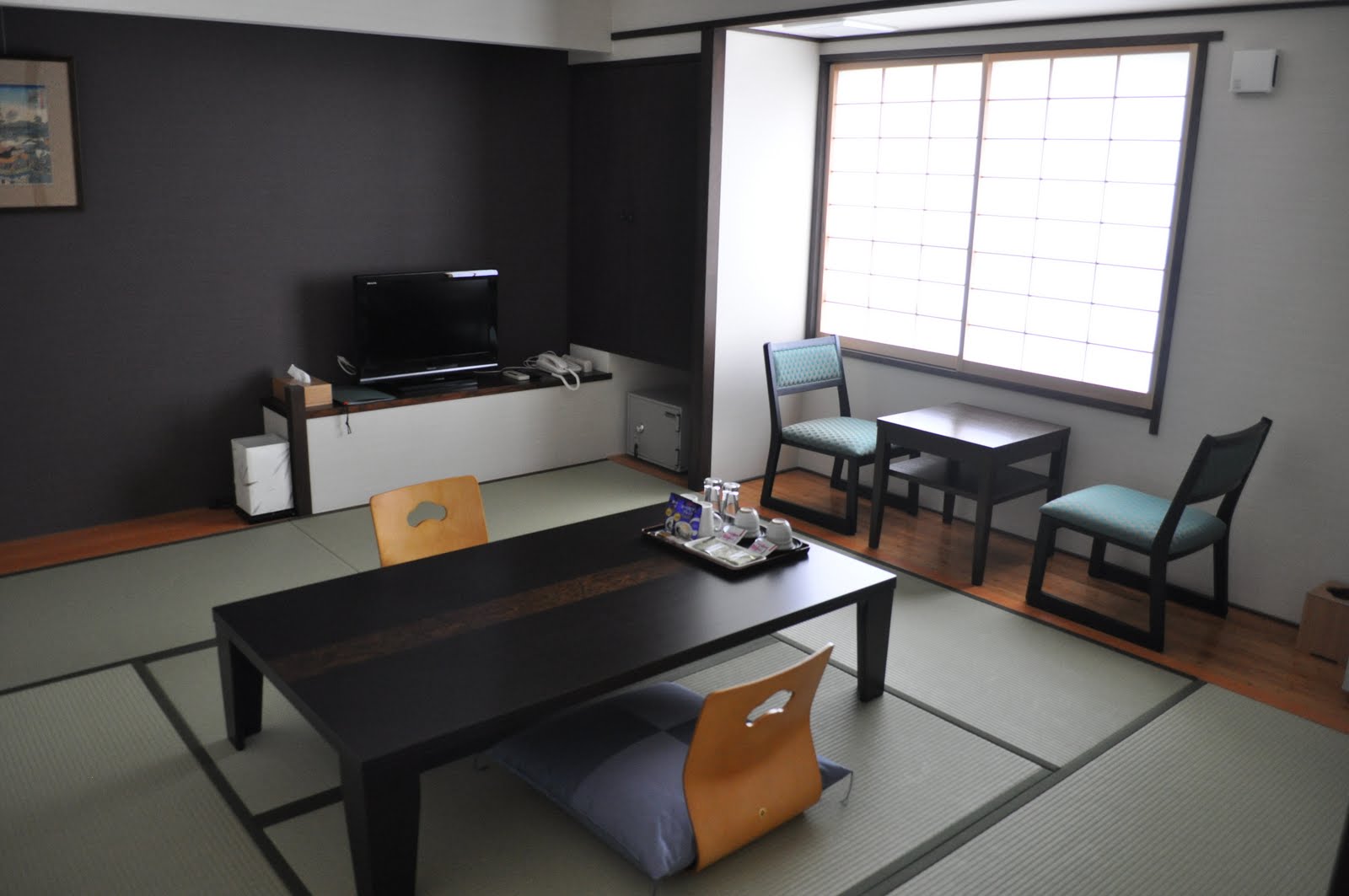
The remainder of the NCTA study tour of the physical and human geography of Japan was spent in Kyoto with a day trip to nearby Nara.  We spent these next several days in a traditional Japanese hotel called a ryokan.  The tatami room (a floor  covered with pale green rice-straw matting) has a table and chairs in the center and nowadays in more modern Japan, instead of flowers and a wall scroll, there is a television and phone in the alcove (tokonoma) on one wall. At night the table is removed by the staff and the futons are placed on the floor for sleeping. The futons are thick and very comfortable to sleep on.  Off of the entrance way there is a bathroom and separate toliet room.  One is expected to shower first when in the bathroom while standing or sitting on a small stool outside the bathtub and then once washed you can soak in the tub for awhile.  You never enter the bathtub before washing!

Friday, July 23, 2010

A Daytrip to Nara

While staying in Kyoto, our group took a day trip to Nara.  Founded in 710 on the Yamato Plain, then known as the "citadel of peace" Nara was Japan's first capital (then Kyoto and then Tokyo).  It was here in the 7th and 8th centuries that Buddhism along with Chinese script and technology became firmly established in Japan through Korea, as Nara was located at the far end of the Silk Road.  Under the patronage of court nobles many magnificent temples and works of art were built, many of which still survive today.  We started the day trip with small group excursions to the Kasuga Grand Shrine.  This shrine was originally the family shrine of the Fujiwaras, one of the families that helped to establish Nara.  The original building was built in 710, but as part of the rules of purity and renewal in the Shinto belief system, the building is demolished and rebuilt every 20 years.  The current building has been preserved since 1863.  


Surrounding the shrine is a wooded area that contains roads lined with over 3,000 stone and bronze lanterns!  These shrines have been donated over the centuries by ordinary people as tokens of faith and thankfullness.  As beautiful as it was to walk the hill to the shrine, while gazing upon these lanterns, it must be an incredible experience to be here in early February (as part of the Last Day of Winter Festival) and mid-August (as part of the "Obon" or Festival of Souls) when all 3,000 lanterns are lit for several days!

Next, our group visited the Todai-ji (The Great Eastern) Temple and gazed upon the 53-foot bronze Daibatsu (The Great Buddha).  The temple was founded in 745 by Emperor Shomu to help ward off the terrible epidemics that regularly swept the nation, but also as showing of his power.  The temple is quite impressive.  It took 15 years to build and was (and still is) the world's largest wooden building!  (Although now the current structure dates from 1709 and is only 2/3rds the size of the original).

The temple has to be so large because it holds a colossal bronze image of a Buddha (Daibatsu) sitting on a lotus, serving as the Cosmic Buddha, who presides over all levels of the universe.  This Buddha was a phenomenal achievement at the time and is the largest in Japan.  Over the centuries the Buddha has endured tough times, loosing its head in a 9th century earthquake and its right hand in a fire in 1180.  As a result only small fragments of the original remain with patchwork parts put together over the century-although it was hardly noticed by me!  I gazed in wonder at Daibatsu as it sat in the center of the Great Buddha Hall.  It's gigantic size, taking up the entire structure and dwarfing all of us visitors as we walked around the hall.  It is truly a wonder of technological achievement and a very moving experience.

After leaving the Todai-ji, we walked past the Five-Storey Pagoda, which belonged to the Kofuku-ji, one of Nara's great temples in the 8th century.  We also had time to walk through Nara Park, home to more than a thousand semi-wild deer.  They were originally regarded as divine messengers of one of the Kosuga-jinja's Shinto gods, and anyone who killed a deer was liable to be killed!  During World War II the number of deer dwindled to just 70, but now they are back by the hundreds!  They are VERY friendly and constantly looking to the many visitors to Nara for treats.  (They are fed by the locals on a daily basis)  One member of our group bought the sembei crackers and the deer came running!  A wild sight for a tourist from the US who isn't used to such tame deer!

Sue and I enjoyed a quick lunch with our friend Ria and hoped the return train to Kyoto just in time for a lovely Shojin Ryori group dinner at Kodai-ji TK Kuan Restaurant.


Thursday, July 15, 2010

The Kyoto Gion Matsuri

How exciting to be in Kyoto for the Gion Matsuri Festival!  Our participation in the NCTA study tour was over and now we were spending some extra days in Kyoto to be a part of the Gion Matsuri Festival.  The word matsuri means festival in Japanese.  The Gion Matsuri takes place in July and is one of the most famous festival in Japan.  The festival began in 869 when so many people were suffering from illness.  It became shortly became an annual event to appease the gods and to prevent sickness, floods, fire and earthquakes.  


(Photo By Susan Kopecki)
There are 32 floats in the parade, decorated with beautiful tapestries and carrying many traditional musicians and artists.  This festival is the most well attended festival in Japan, with thousands of people visiting Kyoto from all over the world.  


(Photo By Susan Kopecki)
Later in the day, after the parade, children carry the shrines through their neighborhoods as another important part of the Gion Matsuri tradition.  Everyone loves to wear their Yukata at the Gion Festival.  


Many people enjoyed sitting by the river in Kyoto on this beautiful summer night.  Japan hosts a wide variety of dress amongst its people, especially during festival season and the hot weather of summer.  Many people enjoy wearing their Yukata, a casual summer kimono to the Gion Matsuri Festival in Kyoto.  


(Photo By Susan Kopecki)


We, too, enjoyed dressing in our Yukata in Kyoto for the festival!

Wednesday, June 30, 2010

My Stay in Nagayo

After Kyoto, Sue and I boarded a train bound for Nagayo, Japan, the sister-city of Wethersfield, CT.  Susan is going there to establish a sister school relationship with Nagayo Elementary School.  I accompanied her as a fellow educator from Connecticut.  Nagayo Town, is a part of the Nagasaki Prefecture and is located on the island of Kyushu.  Kyushu, is the third largest island of Japan and the most southerly island of the four main islands.  It has a population of just over 13 million.  The island is very mountainous with Japan's most active volcano, Mt. Aso located on Kyushu.

We were welcomed whole-heartedly by Mayor Hayama, the Deputy Mayor and Superintendent Kuroda and enjoyed a wonderful welcome dinner when we first arrived.  We enjoyed our stay in Nagayo immensely.  Everyone at the Town Hall was so gracious and welcoming.  Nabuko and Ayaka were are our translators for us during our stay.  We became good friends very quickly!

The next day we toured Nagayo Town.  Nagayo Town is located in Nagasaki Prefecture and has a population of about 42,000.  It has has a long standing sister city relationship with Wethersfield, Connecticut.  As part of our tour of the town we visited "Wetherfield Street" and saw the tree planted by a past visit by the Mayor of Wetherfield.  Later that day we drove about 10 miles to Nagasaki and toured the Peace Park.  Nagasaki was the site of the 2nd Atomic Bomb that was dropped on the city August 9, 1945.  It was a very somber afternoon but one that we will never forget.  My prayer during that afternoon was "Never Again."

Later that day we also visited _________ and had dinner at a __________.

Before leaving the Nagayo, we were warmly welcomed by Superintendent Kuroda and the Nagayo Elementary School staff.  We toured the school and took part in their Closing Cermony.  They were ending school for their month long summer break and Mrs. Kopecki and I were the guests of honor!  The students were told by their principal to have a safe summer vacation and to remember to keep up with their studies during the break. Mrs. Kopecki and I then each gave a speech about how happy we were to be there to be a part of their closing ceremony and how we can't wait to go back to the United States and tell our students all about our warm welcome by Nagayo Elementary School Staff and students.  The students sang a song welcoming us to their school and then a group of 6th graders gave a special performance that left both Mrs. Kopecki and I speechless!  It was truly a morning I will never forget!

Before boarding a train for Tokyo, we had lunch with the Mayor once again at Nagayo Town Hall and took a tour of the Town Hall.   I was amazed at how large the town hall was for a town of 42,000.  We were then given a royal send-off with many Town Hall employees as well as the mayor and deputy mayor escorting us to the door and waving good-bye as we drove away to the train station.

My short time